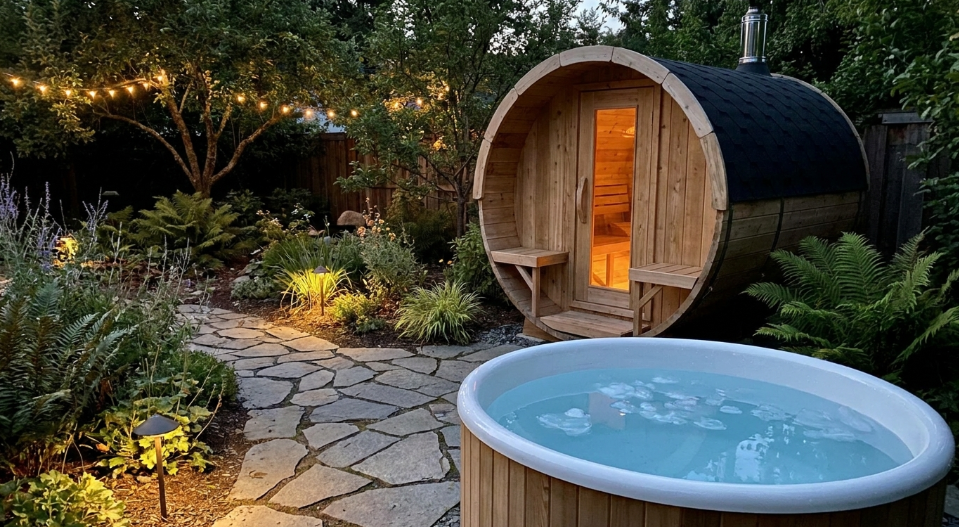
The five most common barrel sauna mistakes are assuming the diameter alone tells you the usable headroom, treating the steel hoops as maintenance-free, picking a door orientation without checking prevailing weather and site lines, setting the unit on bare ground instead of a proper base, and skipping a small entry overhang. Every one of these is specific to the barrel’s round shape, and every one is cheap to avoid if you catch it before the kit ships.
Mistake One: Assuming Diameter Equals Usable Headroom
A 7-foot diameter sounds roomy, and it is at the center of the barrel, directly under the peak of the curve. But the ceiling slopes down toward the outer walls, so the actual standing and sitting headroom near the bench, where you spend most of a session, is meaningfully less than the diameter number suggests. Two barrels advertised at the same diameter can feel quite different depending on bench placement and how close it sits to the curved wall. Ask for interior height at the bench location specifically, not just the overall diameter, especially if anyone using it is over six feet tall.
Mistake Two: Treating the Hoops as a Set-and-Forget Detail
A framed cabin sauna, once built, doesn’t have a structural component that needs periodic tightening. A barrel does. The steel hoops compress the vertical staves tightly enough to seal the joints between them, and wood shrinks and swells with seasonal humidity, which means a hoop that was snug at delivery can loosen over months. Buyers who don’t know this skip checking it, and a loose hoop eventually shows up as a faint draft along a stave seam. Budget five minutes a season for a hoop check, and ask before buying whether the tightening hardware is something you can adjust yourself or something that needs a service call.
Mistake Three: Picking a Door Orientation Without Thinking It Through
A barrel’s door sits at one flat end of the cylinder, fixed for the life of the unit once it’s assembled, unlike a square cabin where a door can sometimes be specified on any wall. Buyers who don’t think about orientation before assembly can end up with a door facing straight into prevailing wind and rain, or facing a neighbor’s window instead of the yard’s better view. Walk the install site at different times of day and note which direction storms typically come from before you bolt the frame together, since repositioning a fully assembled barrel later is a much bigger job than deciding correctly the first time.
Mistake Four: Setting the Barrel Directly on Grass or Bare Dirt
A barrel rests on a steel cradle stand, not a full flat sill, and that stand needs a flat, well-drained surface underneath its contact points. Buyers eager to get the unit assembled sometimes skip ground prep entirely and set it straight on lawn, which looks fine for a season and then starts causing uneven settling as the ground shifts with rain and frost, throwing the door slightly out of square over time. A basic gravel pad, four to six inches deep over compacted base material, solves this for a few hundred dollars in materials and a weekend of labor, and it’s far cheaper to do before delivery than to correct after the barrel has already settled unevenly.
Mistake Five: Skipping a Small Overhang Above the Door
Because a barrel’s door sits flush against the curved end wall, rain and snow can run directly down onto the entry step and the door seal itself with nothing to deflect it, unlike a cabin with eaves that naturally shed water away from the entrance. A simple canopy or covered porch add-on, often $200 to $600 depending on the manufacturer, keeps the door gasket drier and the entry step safer in wet or snowy weather. It’s a detail that’s easy to skip at checkout to save a couple hundred dollars and one that a lot of owners add back within the first winter anyway.
Bonus: Not Reading the Warranty Closely Enough
Barrel sauna warranties often split coverage in ways that surprise buyers: the wood staves might carry one warranty period, the steel hoops another, and the heater a separate, usually shorter, term entirely. A cabin’s flat wall panels don’t have this three-way split, so buyers coming from that mental model sometimes assume “the sauna” is covered as one unit when it isn’t. Read exactly what’s covered on the hoops specifically, since replacing a damaged one outside of warranty is a real cost most buyers never budget for.
How to Vet a Kit Before You Order
A few direct questions to a manufacturer or retailer catch most of these mistakes before money changes hands. Ask for interior height measured at the bench location, not just the overall diameter. Ask whether the hoop tensioning hardware is something you can adjust yourself or something that requires a service call. Ask which direction the door faces relative to the barrel’s shipped orientation, since some kits are only sold with one fixed door position rather than a choice at assembly. Ask what base the manufacturer recommends underneath the cradle stand, and whether skipping it affects any part of the warranty. None of these questions take long, and a retailer or manufacturer that can’t answer them clearly and specifically is worth a second look before you commit to a particular model and diameter.
What Ties These Together
None of these five mistakes are about picking a bad brand. They’re about applying a mental model built for framed cabins to a construction method that behaves differently in a handful of specific ways. A buyer who checks bench-level headroom, understands the hoops need occasional attention, thinks through door orientation, preps the ground properly, and adds a small overhang ends up with a barrel that holds up for years. Once you know what to check, comparing models and prices is straightforward; you can shop the current options with that checklist in hand rather than going in blind.
Frequently Asked Questions
Does barrel diameter tell you how much headroom you’ll actually have?
Not by itself. A curved roof drops toward the outer walls, so two barrels with the same diameter can feel different depending on bench placement.
Do barrel saunas need more ongoing maintenance than a cabin sauna?
A bit more in one way: the steel hoops need periodic checking and tightening, a step a framed cabin doesn’t have.
Why does door orientation matter for a barrel sauna specifically?
The door sits at one fixed end of the cylinder, unlike a square cabin where the door can often go on any wall.
Can you place a barrel sauna directly on grass or dirt?
It’s not recommended. The cradle stand needs a flat, well-drained surface like gravel or pavers to avoid uneven settling.
References
- Clinical Effects of Regular Dry Sauna Bathing: A Systematic Review (Evidence-Based Complementary and Alternative Medicine, 2018)
- Cardiovascular and Other Health Benefits of Sauna Bathing: A Review of the Evidence (Mayo Clinic Proceedings, 2018)
- Benefits and risks of sauna bathing (The American Journal of Medicine, 2001)
- National Fire Protection Association