Nobody walks into a store and asks about wattage. That’s just not how it goes. You check the price, recognise a brand name or don’t, maybe notice the finish. Then you buy it, the electrician fits it, and everyone moves on. Six months later, the motor’s groaning halfway through a coconut and the idli batter has the wrong texture entirely, and nobody can figure out why. It isn’t the brand. It isn’t bad luck either. It’s that the kitchen mixer grinder you bought was never matched to what your kitchen actually asks of it.
Why Indian Cooking Is Harder on a Motor Than You’d Think
Most product pages describe mixer grinders as if they’re all doing roughly the same job. They aren’t. A blender in a Western kitchen handles soft fruit. Yoghurt. The occasional blended soup. Your kitchen mixer grinder is dealing with something completely different: raw coconut that genuinely resists the blade, whole dried spices with almost no moisture content, and idli batter that needs the motor running continuously for three to four minutes without a break.
That last one is the part that doesn’t get mentioned enough. Running under load for several minutes builds heat inside the motor. That heat, repeated daily over months, is what shortens a motor’s life well before its time.
If you want the best mixer grinder for a kitchen that does serious daily cooking, this is the thing to understand before you look at anything else.
See also: 3D Printing in Tech: More Than Just Prototypes
What the Wattage Numbers Actually Mean in Practice
500 watts. 750 watts. 1000 watts. Worth being direct about what each one actually delivers.
Five hundred watts handles the everyday tasks without any drama. Fresh chutneys are fine. Small smoothies, pre-soaked spices, soft fruit. If that covers most of what your kitchen needs, a 500-watt machine is entirely adequate, and there’s no real argument for spending more. It runs cooler, it’s quieter, and because it’s rarely pushed anywhere near its ceiling, it tends to hold up well over the years.
Seven hundred and fifty is where the machine stops just coping and starts performing. One pass on hard, dry spices instead of two or three. Full batter quantities for a family without the jar getting warm halfway through. It’s a genuine difference, not a marginal one.
Above 750, the returns get narrower fast. A 1000-watt machine earns its place in a large joint family kitchen where multiple full batches are running every day, or where genuinely tough ingredients, such as raw turmeric and hard dried corn, come up regularly. For most urban households, cooking for three or four people? The extra power mostly shows up as extra noise and a higher price tag.
The Specific Tasks That Show Up the Difference
Batter is the real test. Always has been. Urad dal and rice, properly soaked, need sustained effort to reach the smooth and slightly aerated texture that makes idlis come out right. A 500-watt kitchen mixer grinder gets through a small batch but starts to labour on anything bigger. At 750, the same quantity finishes quicker, the texture is more consistent, and the motor isn’t warm to the touch when you’re done.
Dry spices are the other honest test. Coriander seeds, dried red chillies, black pepper, and fenugreek. These need impact more than speed. Under 600 watts, you’re usually grinding twice and still getting slightly coarse powder. At 750, it’s done in one go.
Coconut is where most people realise too late that they bought the wrong machine. Dense, fibrous, doesn’t give easily. Small quantities get through below 600 watts, but a full coconut needs 750 to grind cleanly without stopping the machine twice to redistribute the contents.
Jar Count Matters As Much As Motor Power
A well-specced motor in the wrong jar gives you bad results. This gets ignored almost every time because jar configuration sounds like a minor detail next to wattage. It isn’t.
| Jar Type | Capacity | Best Used For |
| Large wet grinding jar | 1.5 litres | Batter, chutneys, large curry bases |
| Dry grinding jar | 0.75 litres | Whole spices, dry masala blends |
| Small chutney jar | 0.3 litres | Small-batch fresh chutneys, pastes |
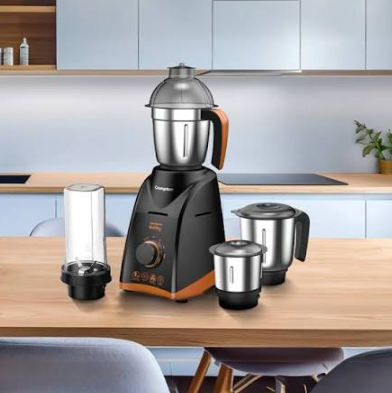
Put a small quantity of dry spices in the large jar, and the blades don’t reach them properly. Push batter volume through the small chutney jar and the coupling strains, the seal wears. Three jars, each used for what it was designed for, is what a properly set-up kitchen mixer grinder actually looks like.
Conclusion
Wattage is the number that decides whether your kitchen mixer grinder handles daily Indian cooking without straining the motor, and whether it’s still working properly in year seven or needs to be replaced in year three. Get it right, match the jars to the tasks, and the machine just sits there doing its job without asking for attention.
Buying too little, trying to save a few hundred rupees, and the savings disappear quickly. It rarely works out the way people expect.